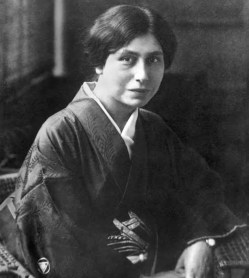
 Mirra Alfassa was born in Paris in 1878, the daughter of Sephardic Jewish immigrants from the Ottoman Empire. Her parents belonged to prominent banking families. Mirra received no religious training and never identified as Jewish, but she absorbed the refined cultural values of her milieu, and also felt the sting of the anti-Semitism that pervaded late nineteenth-century France.
Gifted in music and painting from childhood, she came of age in the Paris of the Belle Époque, when the city was the artistic capital of the world. She studied painting at the Académie Julian, exhibited at the annual salons, and moved in the same artistic circles as Rodin, Matisse, and Bonnard. In 1897 she married fellow painter Henri Morisset, whose work was highly regarded at the time. After 1905, Mirra’s artistic ambitions gave way to other interests. Putting aside her brush, she turned her attention to philosophy, spirituality, and the occult.
Her spiritual awakening began with the teachings of Max Theon and his wife Mary Ware, leaders of the Cosmic Movement, which played a significant role in the French occult revival. Under their influence Mirra served as editor of La Revue Cosmique and published visionary writings of her own. Her marriage with Morisset ended in divorce in 1908 and soon afterward she distanced herself from the Theons as well. By 1911 she had set up a household with the lawyer and writer Paul Richard, with whom she would collaborate intellectually for the next decade. Mirra was the uncredited co-author of Richard’s books and moved with him in Parisian intellectual and spiritual circles. An active if moderate feminist, she participated in meetings of the Union of Feminine Thought. She also formed a lifelong friendship with the writer and explorer Alexandra David-Neel, who later became the first Western woman to enter Tibet.
Mirra’s search for knowledge brought her into contact with Asian spiritual teachers, most notably Inayat Khan and Abdu’l-Baha, but it was her introduction to the Bhagavad Gita that gave her the framework she sought: a vision of the divine as immanent in every human being and a path of inner discipline rather than external ritual.
In 1914 she accompanied Paul Richard to Pondicherry, India, then a French colony. There they met Aurobindo Ghose, the revolutionary turned philosopher and yogi. Together with him they launched a philosophical journal. With the outbreak of World War I, the Richards returned to France and later traveled to Japan, where they met Nobel-prize-winning writer Rabindranath Tagore, Irish poet James Cousins, and Japanese intellectuals and artists. In 1920 they returned to India and resumed their association with Aurobindo. Richard soon left; Mirra remained.
From that point on, Mirra’s life was intertwined with Aurobindo’s. He recognized her unusual spiritual capacity and organizational abilities, and soon accepted her as his chief collaborator. In 1927 he withdrew into seclusion, leaving Mirra—now known simply as “the Mother”—to guide the ashram that had formed around him. Over the following decades she oversaw its expansion from a modest group of two dozen into a thriving community of three thousand, with farms, workshops, schools, and cultural institutions. Her conversations with disciples, later published in multiple volumes, conveyed her vision of integral yoga: a way of uniting spiritual realization with practical life.
After Aurobindo’s death in 1950, the Mother remained the head of the ashram, which continued to attract visitors from around the world—among them the novelist Maurice Magre, the surrealist poet Valentine Penrose, and Indian leaders including Jawaharlal Nehru and Indira Gandhi. She was admired not only for her spiritual guidance but also for her vitality and organizational brilliance; she played tennis well into her seventies and guided a major educational experiment in the ashram’s school.
In the mid-1960s she conceived her most ambitious project: Auroville, an international township dedicated to human unity. Inaugurated in 1968 with the support of the Indian government and UNESCO, it drew young people from Europe, America, and across India to settle on barren land outside Pondicherry. Under her inspiration, three million trees were planted, and the community flourished. She remained involved in its development until her death in 1973 at the age of ninety-five. She was buried alongside Sri Aurobindo in the ashram courtyard.
Scorning religion yet revered as a spiritual guide, grounded in Parisian culture yet dedicated to a radical Indian experiment, Mirra Alfassa lived one of the most remarkable lives of the twentieth century.

